Debate Matters: How classic debate helps you develop confidence and a personal speaking style.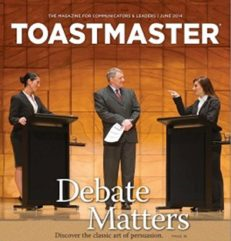
“The debates you see on TV are more showmanship,” says Roberta Hyland, second vice president of the National Catholic Forensics League, an organization that runs local and national debate tournaments for high school students throughout the United States. “The structure of an academic debate normally has a single topic, and involves more back-and-forth. There’s going to be more point-counterpoint extension of a particular thought. The way we refer to [academic debate] is that there’s going to be more clash, and it’s going to be substantive clash.”
If that sounds unusually belligerent for an academic contest, the participants don’t look at it that way, Hyland says. “Clash doesn’t have the emotional ramifications you might associate with the word,” she says. “It’s more of the fact that the ideas being expressed should conflict. It’s the clash of ideas, not emotions. And, of course, the debate is very structured.” While debate students learn how to develop a convincing argument, they also develop and improve their speaking styles.
Debate styles are developed through the mastery of the tone and volume of the speaker’s voice, and the rate of his or her speech. You can develop your own speaking style by practicing debate formally in your club (consult the Toastmasters Debate Handbook: A Guide to Competitive Speaking (item 104) for more information). Have members take turns debating both sides of an argument. They will learn that whichever side of the topic they argue, the point is not as much about which side they take, but how they are able to support their arguments logically. Master delivery through debate and you too can speak confidently, logically and persuasively about any topic.
Public policy debate: This is the oldest and likely best-known form of debate practiced at both the high school and college levels. A single topic is debated all year. For example, the U.S. public policy debate topic for 2013-2014 is “Resolved: The United States federal government should substantially increase its economic engagement toward Cuba, Mexico or Venezuela.” Two students form each team. One team (the affirmative side) argues in favor of a previously selected proposition, while the other team (the negative side) argues against it. The debate features four constructive speeches and four rebuttal speeches. The team with the strongest evidence and most
organized presentation wins.
WHERE LEADERS ARE MADE PUBLIC SPEAKING
Lincoln-Douglas debate: The inspiration for this format was provided by the famous debates between American senatorial candidates Abraham Lincoln and Stephen Douglas in the 1850s. In the Lincoln-Douglas format, one person takes the affirmative side of the argument and one person takes the negative side. In this type of debate you see lots of ‘ought’ terminology,” says Hyland. “That implies some sort of question about morality or correctness, either in the affirmative or the negative.” Other formats, such as public forum and parliamentary debate, allow for more Lincoln-Douglas debate is a one-on-one competition format modeled after the historic debates between U.S. senatorial candidates Abraham Lincoln (left)
and Stephen Douglas (right). informal and persuasive speech, as well as the ability of debaters to think quickly on their feet.preparing a Case Each debate format “involves its own type of preparation, stylistically,” says Hyland. “You don’t only prepare the affirmative; you still have to prepare a case for the negative position, to understand and argue both sides of the argument. It makes you more knowledgeable but also gives you a better understanding of the counter opinion, because you can’t be so firmly entrenched in your own world view. You can’t be a successful debater unless you can debate both
sides of a topic.”
Additional vital characteristics are common to all forms of competitive academic debate: structure, research, reliance on hard and persuasive evidence, and calm courtesy. Paint outside those lines and you lose points. “In a formal debate, both sides are expected to be courteous, professional and calm,” says Dr. Susan Ohmer, director of debate at the University of Notre Dame. “They win through persuasive arguments—through reasoning, through credibility—not through any power move. In fact, if someone were to raise his voice or sound shrill or make a personal attack or say, ‘You’re lying’ or ‘That’s just not true,’ that would not be appropriate in a formal debate because that’s not refuting an opponent’s argument with reasoning. They may not get called on it by the moderator, but they would lose significant points for that. You win and lose points on the strength of your argument.”